
New crossovers for KEF LS50
Speaker design features

KEF LS50 speakers
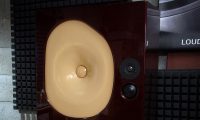
KEF LS50 – two-way bookshelf speaker systems of the bass reflex type, equipped with coaxial drivers. The tweeters are located in the center of the mid-bass drivers, which are framed by small horns that visually smoothly transition into the mid-bass speaker cones. Both speakers are mounted on a single common magnetic system.

Front and back view
The design of the enclosures of these speaker systems attracts special attention: a thick-walled monolith with many stiffening ribs! This is incredible: such a solid and complex enclosure is rarely found even in much more expensive speaker systems. Very good, I am pleasantly impressed with the internal and external design of these speaker systems.
New crossovers


Wiring and schematic diagrams
I’ll note right away that my workshop received disassembled speakers without standard crossovers, which, by the way, were once active (LS50 Wireless version). Therefore, unfortunately, I did not have the opportunity to evaluate their sound before the crossover upgrade. The task that the customer set me was to make a passive version of these speakers. By the way, the passive version of the LS50 (without the Wireless designation in the model name) is equipped with the same drivers in the same enclosures, so my version of the crossovers can also be used to upgrade these speakers.
So on to crossovers.
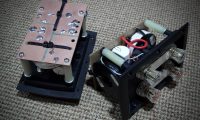
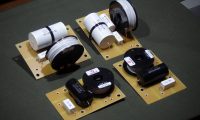
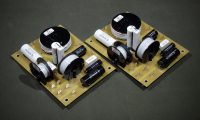
Structurally, the filters are divided into two separate boards, which is due to the peculiarities of their installation inside the housings of speaker systems. The low-pass and high-pass filters are second-order filters with additional frequency response correction circuits. The presence of correction circuits is dictated by the drivers’ own frequency characteristics, which, frankly, can hardly be called uniform. But the uneven frequency response of the drivers is not always an obstacle to getting great sound. Especially if this disadvantage is compensated by other good characteristics, in particular such a subjective and important indicator as resolution. And the KEF drivers demonstrate good resolution.

Frequency response on axis 
off-axis frequency response
Filter complications should not be feared if these complications help stabilize the tonal balance, “reveal” the best qualities of the drivers, and generally improve the sound character of the speaker systems.
For example, the rather complex structure of the high-pass filters helped to form a good and stable directional pattern at the upper midrange frequencies, where, in fact, the baton is passed from the mid-bass driver to the tweeter. Uniform natural decline of the frequency response without obvious spikes and dips in the range of 1.5 … 3 kHz does not exceed 3 dB even when the measuring microphone is deviated from the speaker by an angle of 45° in the horizontal plane. At high frequencies close to 20 kHz, this figure does not exceed 5 dB, which is very good and is achieved thanks to the successful and rather complex design of the tweeter horn. In the vertical plane, the results are about the same, since the speaker systems have coaxial drivers.

Transfer functions of filters 
Impedance
The filter transfer functions are configured in such a way that their graphs display “mirror” frequency responses to the drivers’ own frequency responses.
The filter crossover point is 1.7 kHz.
The speaker system impedance is an average of 4 ohms with a minimum value of 3.5 ohms in the frequency range 200 … 300 Hz
Sounding
Subjective impressions:
These speaker systems left a very pleasant impression, I am completely satisfied with the result of the work. And the customer of these speaker systems is also satisfied. After careful work on the crossovers, you can listen to these speaker systems for hours without getting tired, both in the background and at quite high volumes.
A solid, collected sound, the music does not break up into separate fragments, sound images are transmitted adequately and naturally. And most importantly, the sound is emotionally captivating, which is a very good sign that the speaker systems are properly tuned.
The dense and fairly deep bass was a nice bonus, considering the size of these little guys. Despite the rather modest limit of 50 Hz (at the level of -3 dB) and a rather sharp drop in frequency response below (12 dB/oct, which is typical for a bass reflex), one might think that these speakers would be modest in bass. But no, the KEF LS 50 demonstrate a fairly fundamental sound thanks to the successful tuning of the bass reflex and crossovers. By the way, an interesting fact: the subjective perception of “bass depth” depends much more on the evenness of the balance of mid and low frequencies than on the formal lower limit of frequencies reproduced by acoustic systems. Conventionally speaking, a speaker with a 50 Hz low-frequency cutoff but with an equal frequency balance of low and mid frequencies will sound subjectively “deeper” than a speaker with a curved frequency response balance but a lower limit of 30 Hz.
If we return to the frequency response measurements of these speaker systems, formally its uniformity fits into the +/- 2 dB corridor in the frequency range of 50 Hz … 20 kHz. Thanks to the good resolution of the drivers and the correct setting of the crossovers, the sound is detailed and collected, without coloration of the tonal balance. Truly “monitor” in the best sense of the term.
I have heard many times from audiophiles that the supposedly “monitor” nature of speaker systems creates a lifeless, dead, sterile sound. And that deliberately created accents in certain frequency ranges, on the contrary, add “life” to the sound. In fact, this is absolute nonsense :). People may like some pleasant timbre colors of speaker systems, which can accidentally emphasize the sound character of certain musical compositions. On the other hand, other compositions on such speaker systems are guaranteed to sound somewhat distorted in terms of timbre. In my deep conviction, speakers should sound as transparent as possible without distortions in timbre and colorations in tonal balance. That’s why I always try to achieve exactly this result in my developments, no matter whether they are speaker systems of my own production or branded speakers for which I develop new crossovers or upgrade them.
And finally…
Don’t forget, friends, to make donations to the needs of our military unit where I currently work.
Please visit the main page of the site, where you will always find a link for financial assistance to us.
We and our brothers will be very grateful to you!
Victory and Peace!